How Google Decides Which of Your Keywords Serves
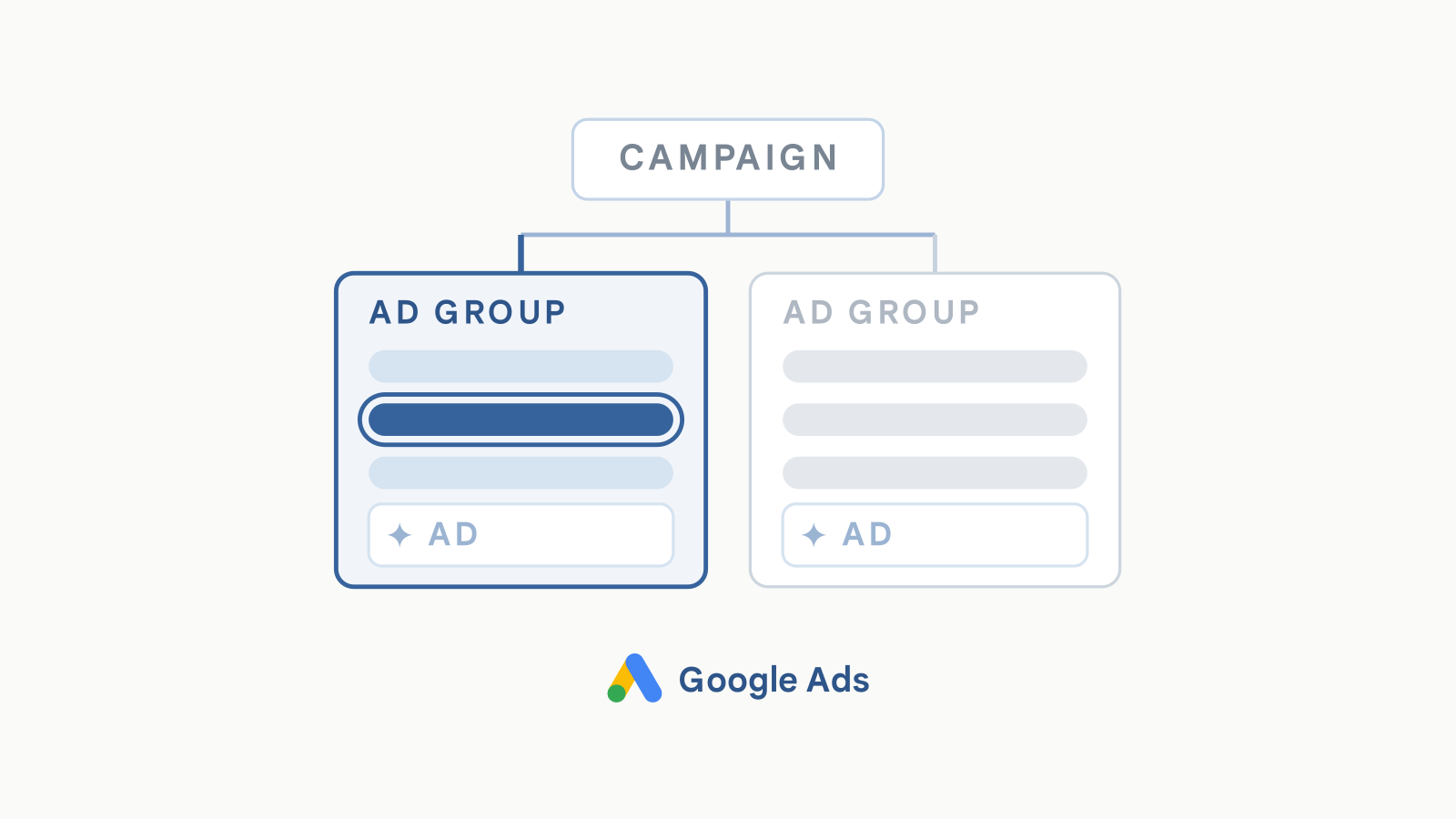
Say you’re a plumber and your account has these three keywords. Emergency plumber, on exact match. Emergency plumbing service, on phrase. And plumber, on broad.
Somebody searches for emergency plumber. All three of those keywords could match that search. Only one of them is going to.
Most people assume it’s either the closest match or the one with the highest bid. Google publishes the actual answer, and it’s four levels deep, in a help page most advertisers have probably never looked at.
That matters for more than curiosity. In the keyword research post I said the exact match terms you know convert are still worth protecting, and that what’s changed is where you put them. This is where I make good on that, because you can’t decide where a keyword should live until you know how Google picks between them.
The four tiers
The page is called About ad group and asset group prioritization within a Google Ads account. It used to be called keyword and search theme prioritization, so if you go looking for it, search both.
There are four levels, in order:
- Exact match keywords that are identical to the search term. Google’s example says an identical exact match keyword is prioritized over any other broad or phrase match keyword, and over a Performance Max campaign.
- Phrase and broad match keywords, including AI Max, or search themes that are identical to the search term.
- If nothing is identical, AI-based relevance decides which ad group matches.
- If everything above is equal, Ad Rank.
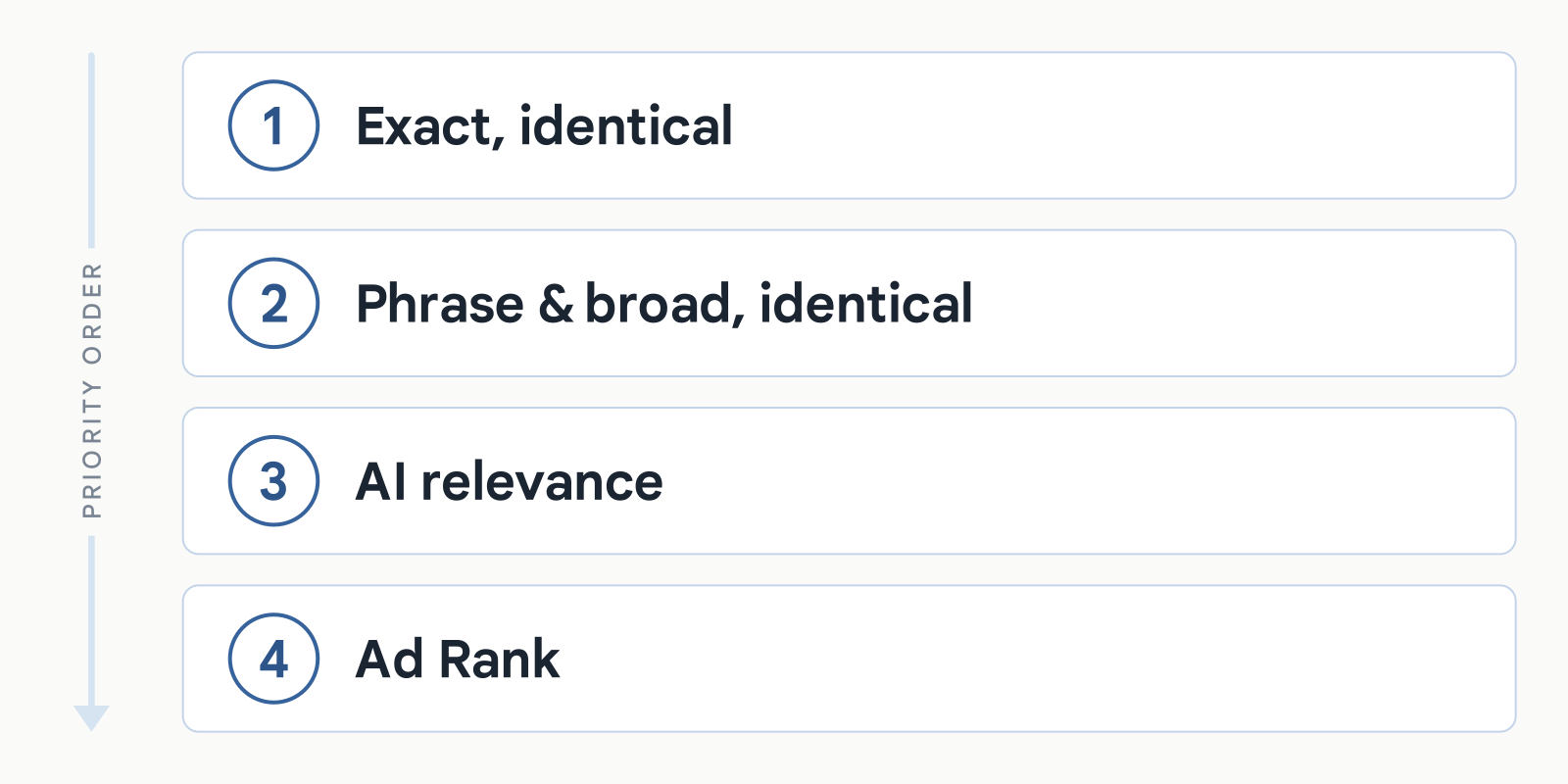
So back to the plumber. Somebody searches emergency plumber, and you’ve got it as an exact match keyword. Tier one. It wins, and it doesn’t matter that your broad keyword might also have matched.
Google defines identical in a footnote. It includes spell-corrected search terms. It does not include plurals or synonyms.
“Identical” includes spell-corrected search terms, such as skydiving license, but doesn’t include plurals or synonyms like license for skydiving.
Somebody searches emergency plumbers, plural. That isn’t identical to emergency plumber. Your tier one protection doesn’t apply, and you’ve dropped to relevance.
| Your keyword: [emergency plumber] | Identical? | Decided by |
|---|---|---|
| emergency plumber | Yes | Tier 1 |
| emergency plumbur (spell-corrected) | Yes | Tier 1 |
| emergency plumbers (plural) | No | AI relevance |
| emergency plumbing (near-synonym) | No | AI relevance |
If you read the negative keywords post, keep these straight, because they work in opposite directions. On the negative side, Google handles misspellings and casing for you automatically, and for negative phrase and exact it does not match close variants. Here, on the positive side, spelling is forgiven and plurals are not.
Same word, identical, doing different work depending on which page you’re reading.
What relevance actually looks at
Most searches don’t have an identical keyword sitting in your account. These days, search behavior is too varied for that, which is the whole reason broad match is heavily recommended as the default now by Google. So in practice, tier three is where a lot of your traffic gets decided.
Here’s what Google says it looks at:
Relevance is determined by the meaning and context of the search term, all the keywords in an ad group, and landing pages within the ad group.
The 2022 keyword matching guide, Unlock the Power of Search, says the same thing, in the same order, and then draws the conclusion for you:
Relevance is determined by looking at the meaning of the search term, the meaning of all the keywords in the ad group, and the landing page within the ad group. … This is why it’s important to group your keywords into ad groups by theme.
Read those two together, because they change what an ad group is.
An ad group used to be a container. You put keywords in it, you wrote an ad for them, and the container was for your benefit. It kept your account organized and it let you match your copy to your keywords.
That’s not what it is now. Your ad group is evidence. Google reads the whole group, the keywords and the landing page together, to work out what that group is about and whether it deserves this search.
Which means a keyword sitting in a sloppy ad group is a weaker candidate than the same keyword in a coherent one. The other keywords around it are part of how it gets judged.
Google’s instruction is one sentence:
Structure your ad groups thematically to clarify which ad group should match for a given search.
Google’s own examples disagree
So how wide is a theme? Google shows you two examples on two different pages, and they don’t agree.
This is from the prioritization page. Two ad groups, each with two keywords, each pointing at its own page:
| Ad group | Keywords | Landing page |
|---|---|---|
| Skydiving License | Skydiving license; how much is a skydiving license | Specific page outlining the licensing process |
| Advanced Skydiving Courses | Advanced skydiving courses near me; advanced skydiving lessons | Specific page for advanced courses |
Two keywords per ad group, each with its own specific landing page. That’s a tight, single theme ad group. That’s a STAG.
And then there’s the one from the last post, from The ABCs of Account Structure. Men’s shirts and men’s pants collapsed into a single men’s clothing ad group.
These are two help pages within Google’s documentation. One shows you two keywords and a dedicated page, the other shows you a whole department in one group.
The skydiving example is the one that follows Google’s own test, because each of those ad groups has a dedicated landing page and a message that fits everything in it.
Which gives you a test you can actually use. Google says your creative assets and landing pages are shared across the ad group. One set of headlines. One page.
So ask: could one set of headlines and one landing page honestly serve every search this ad group is going to match?
If yes, it’s one ad group. If no, it’s two.
That’s Peel and Stick with a different trigger. You peel a group of searches out when they break the page or the message.
For a contractor, that usually lands at one ad group per service page. Water heater repair is one ad group. Drain cleaning is another. Not because the keywords look different, but because they need different pages and different copy.
And if you’ve only got one page listing twelve services, you don’t have twelve themes. You’ve got one, and no amount of ad group structure fixes that. And to be frank, you really should have a dedicated page for each service you offer as well as each location you serve, not just for Google Ads but for Google organic search as well as increasingly as a signal for AI results in search.
Where your proven terms go
You’ve got terms you know convert. Real money, tracked, repeatedly with two or more conversions so they show a trend no matter how small. The old answer was to protect them structurally. Give each term its own ad group, its own ad, its own bid. Or build Alpha Beta, where your proven exact terms live in one campaign and your broad discovery terms live in another, with negatives keeping them apart.
In 2022, Google said this:
In other words, if you use broad match keywords and want to ensure traffic goes to keywords that are identical to the user’s search term, you don’t need to repeat the same keywords in exact and phrase match.
The prioritization page is more specific than that now. Identical still wins, but exact gets its own tier above broad and phrase. If both your exact and your broad keyword are identical to the search, exact takes it.
So the answer is smaller than the question feels. Your proven converting terms go in as exact match keywords, inside the themed ad group they belong to. Same ad group as everything else on that theme. No separate ad group, no separate campaign, no cross negatives holding it all together.
Google does still recommend exact and phrase for specific cases: campaigns without conversion-based goals, campaigns that need specific budgets and goals for specific terms, which is brand and competitor campaigns, and industries where matching only to specific searches is required by regulation.
Brand is the one most people will hit. That needs its own budget and its own target, which puts it in its own campaign under the rule from the last post.
What that protection covers
A couple of exceptions narrow this, both on the same page as the tiers.
First, searches through Lens, AI Mode, AI Overviews, or auto-complete:
In some cases, a user’s search may involve more complex search journeys, for example, searches on Lens, AI Mode, AI Overviews, or auto-complete searches. In these instances, the search term shown in your reporting represents the best approximation of the user’s intent. Because these searches are not considered technically identical to a keyword, keywords may not automatically be prioritized.
So tier one is for searches Google treats as literally identical to your keyword. In those surfaces, it says that may not apply, and you’re on relevance instead.
And those surfaces are growing. Google’s February 2026 marketing guide says AI Mode queries are three times longer than traditional searches, citing Alphabet’s Q4 2025 earnings.
Second, budget. If your campaign is limited by budget, Google says your prioritized keyword may not serve at all:
If a keyword is in a budget-restricted campaign, which means the campaign’s budget isn’t high enough to accrue all possible traffic, the keyword won’t always be able to trigger an ad even if it otherwise could.
That one lands hardest on small accounts, which are usually the ones running against their budget every day.
So there are three conditions on that top tier. The search has to be one Google treats as literally identical to your keyword. The campaign can’t be limited by budget. And the search has to come from the regular results page rather than one of those newer surfaces.
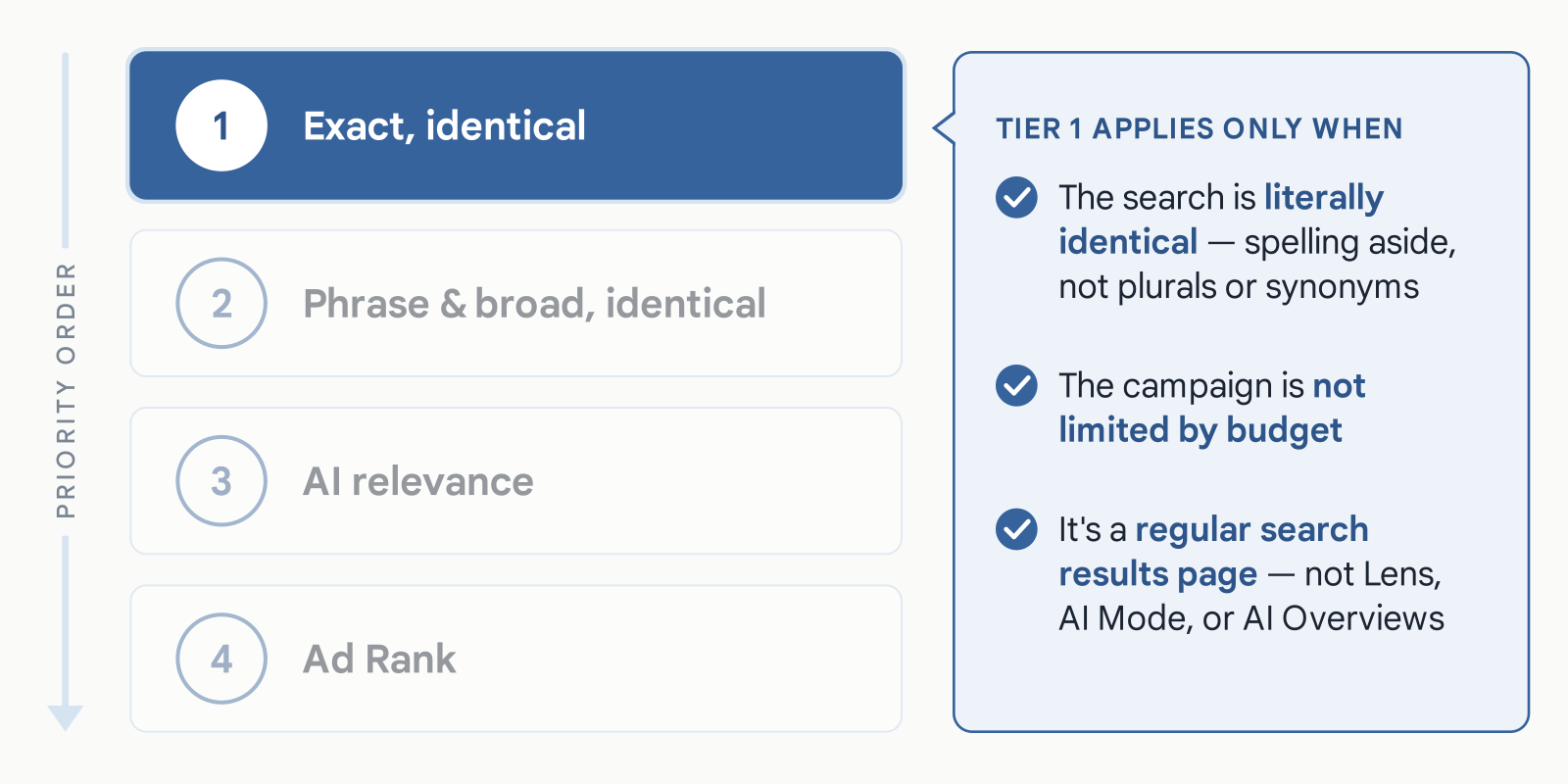
Most searches still meet all three. But AI Mode is one of the places Google says the rule may not apply, and it’s also one of the places Google keeps telling advertisers is growing.
Where that leaves you
Group your keywords by the page and the message they share, not by how similar the words look. Keep exact match keywords for the terms you know convert, and put them in the ad group where they belong. Don’t build separate structures to protect them, because the protection is already in the system, and the structures cost you more than they return.
What’s still open is the same thing that was open at the end of the last post. Relevance gets judged on your keywords and your landing pages together, and nowhere does Google tell you how wide that theme can go.
But notice what just happened to your website. Your landing pages aren’t only where traffic arrives now. They’re part of how Google decides which searches you’re eligible for in the first place.