Why Google Wants Fewer, Bigger Ad Groups
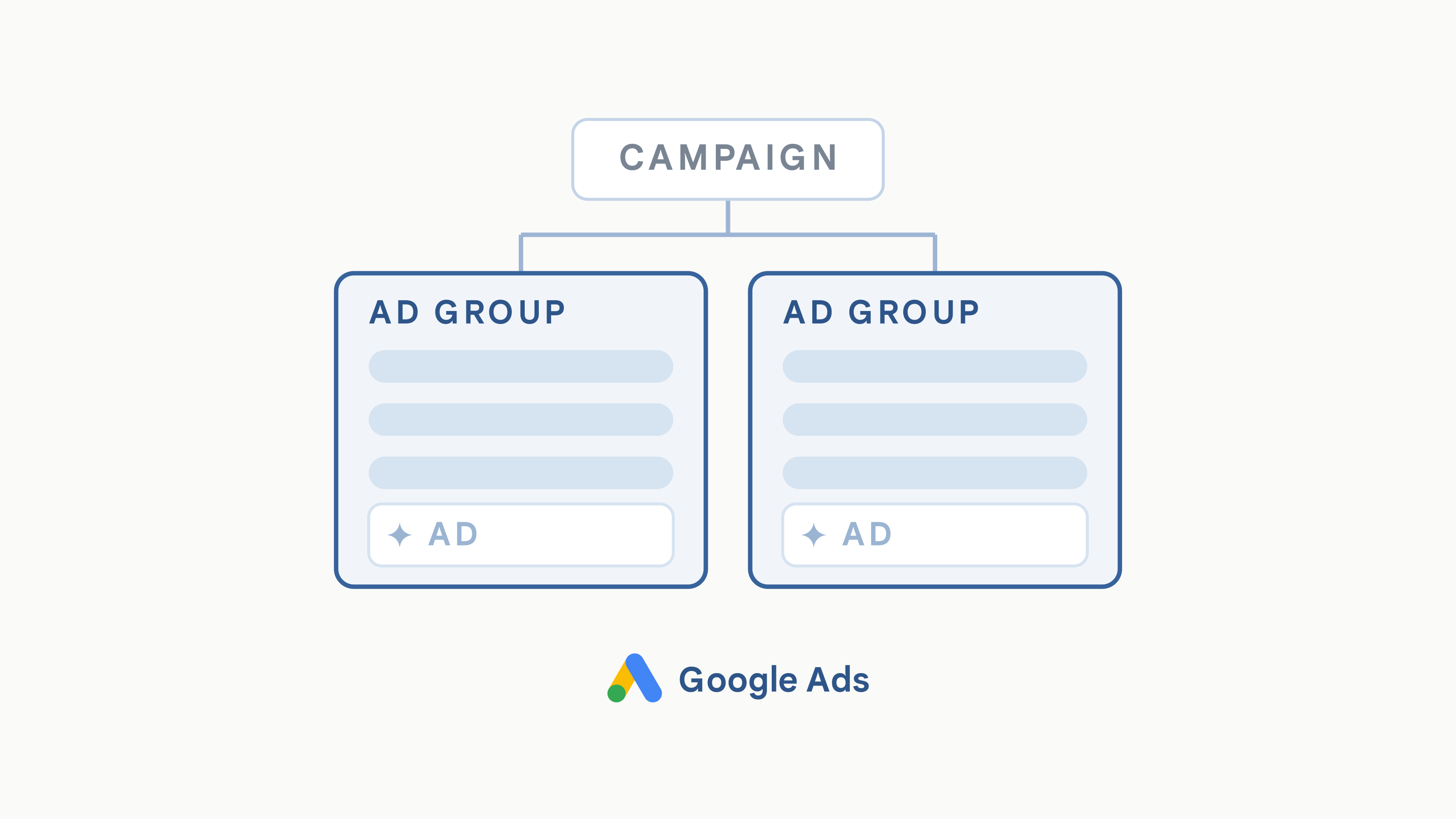
The first edition of the Ultimate Guide to Google AdWords, by Perry Marshall and Bryan Todd, came out in 2007. Back then there wasn’t much written about how to actually run campaigns, so this book, now in its sixth edition, had an outsized influence on how an earlier generation of PPC advertisers built accounts.
There’s a method in chapter ten called Peel and Stick. To understand why it existed, you need to know what happened in the summer of 2005.
In August of 2005, Google introduced the Quality Score. In a post that December, Google said it looked at factors like your ad text and clickthrough rate to determine your minimum bid.
The book describes what that felt like from the advertiser’s side: five cent minimum bids getting pushed up to ten and twenty cents and more.
So your keyword now had a price of admission, and that price depended on how relevant Google thought your ad was. Perry’s answer was two moves.
The first move:
“Take the keyword and stick it into the headline of your ad.”
The second move is the part people forget. If putting that keyword in the headline breaks the ad for the other keywords in the group, you peel it out. You pull that keyword into a new ad group by itself, with an ad built around it.
That’s a single keyword ad group, described in print in 2007.
That logic ran the industry for many years. Google now recommends against it. So the question for this post isn’t whether Google is right in general. It’s whether the reasoning behind that recommendation actually applies to your account.
How grouping got tighter
The book is honest about what was really being measured.
“…the test is not in whether you’re actually relevant to consumers; the test is only in what Google’s computers think looks relevant.”
And it ends the section with the conclusion everybody acted on:
“…break everything down into small, tight groups.”
That’s the whole direction of travel for the next decade, and it’s worth seeing as one line.
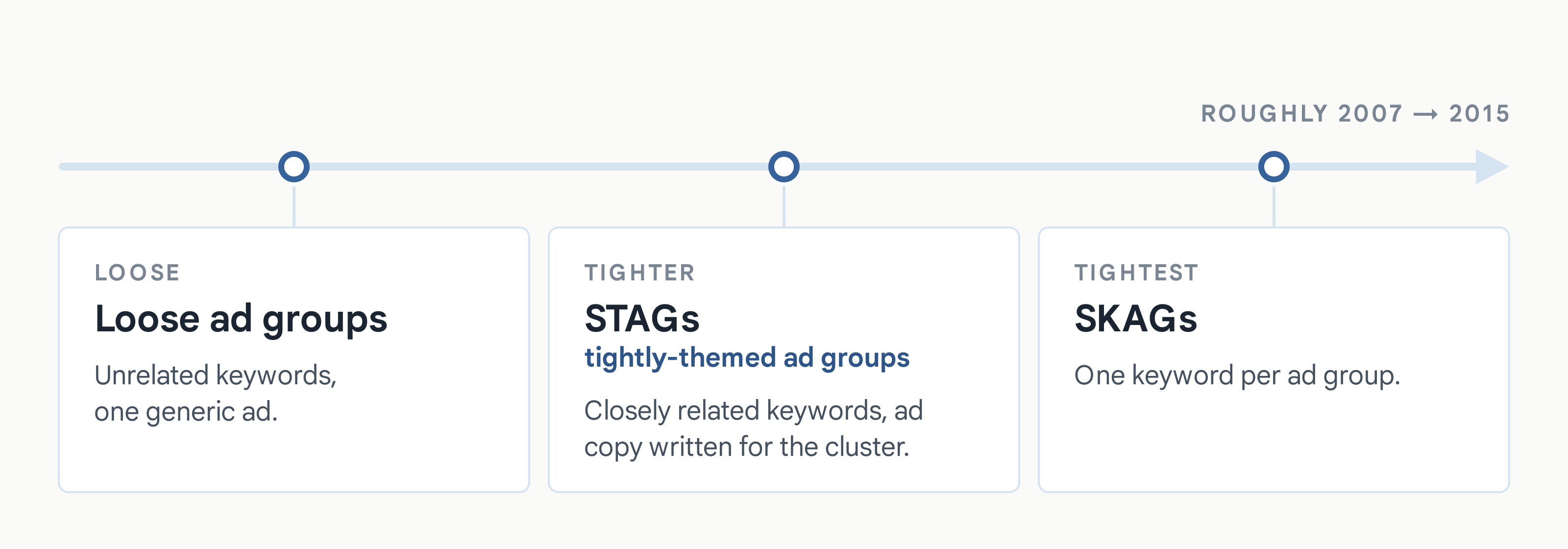
On the left, where most people started, you dump a pile of loosely related keywords into one ad group and run one generic ad.
In the middle, single theme ad groups. Sometimes called STAGs, sometimes called tightly-themed ad groups. A cluster of closely related keywords, with ad copy written for that cluster.
On the right, the end of the line. One keyword per ad group. SKAGs.
I bought that book in 2007 and started grouping keywords into tight themes that year. That year, I became acquainted with someone who had studied with Perry directly, and he showed me how he organized his lists in Excel. I took a couple of ideas from that and built my own method from there.
I started using SKAGs at the end of 2010 when I went to work for an agency in Silicon Valley. By 2015 I’d mostly stopped, because of the close variants changes. I still used them occasionally after that, but they just weren’t as precise anymore.
Some people went further and wrote scripts to hold SKAGs together, pulling the search terms report and pushing exact match negatives back into the ad groups so each one only served its own term. I never bothered. Google had made it clear which direction it was going, and fighting that seemed like a lot of work to preserve something that was already slipping away.
What made SKAGs work was exact match doing what the name suggests. That stopped being true in 2014, when close variants became mandatory on exact match, and it kept loosening from there. I covered that in the match types post.
So the foundation was already cracking. What finished it off was Google removing the other reasons SKAGs existed, and it had done that before in other parts of the platform.
Google has done this before
Two examples, and they follow the same shape.
First one, devices. In February 2013, Google rolled out Enhanced Campaigns.
Before that, most of us ran mobile in its own campaign. Not because we liked the extra work, but because mobile behaved differently. A lot of sites had no mobile version at all. Filling out a form on a phone was miserable. Conversion rates were much lower.
Google’s pitch was that you could now reach people across devices without setting up and managing several separate campaigns. Bids for device, location, and time of day became adjustments inside one campaign.
It wasn’t optional. Google announced that legacy campaigns would be automatically upgraded starting July 22nd, 2013, with default mobile bid adjustments applied for you.
I wrote a post about it at the time, walking through the new bid adjustments and how they multiplied together. I was being diplomatic. What a lot of us actually said was that we didn’t want to bid on mobile at all, because mobile converted terribly, and we resented being pushed into it.
We were wrong. Google could see mobile growing in a way the rest of us couldn’t, and within a few years people were doing everything on their phones.
Google also made money on every mobile click we’d been avoiding. Both things can be true, and it’s worth keeping in mind when you’re weighing today’s recommendations. An obvious incentive doesn’t make the advice wrong.
Here’s Google’s current advice on device targeting: remove device segmentation, because Smart Bidding already takes device into account.
So the structural split became a control lever in the campaigns. It’s something Google tells you not to bother with anymore.
The second example is bidding.
The way I built accounts for years was to set the ad group default bid to one cent, then set every real bid at the keyword level. That gave you control over exactly what each keyword was worth, and you could balance the expensive ones against the cheap ones across the account.
On large accounts, I used to spend hours adjusting bids by hand. I had huge spreadsheets tracking my top keywords, the bid changes, and what those changes did to position, cost, revenue, and profit.
That kind of control doesn’t really exist on automated bidding, which is its own subject and its own post. But one of the main arguments for SKAGs was keyword level bid control, and that argument doesn’t hold up now.
What Google recommends now
Unlock the Power of Search is Google’s 2022 guide to how keyword matching works.
Google recommends one campaign per business objective, and one ad group per creative theme. In the same section, it says it doesn’t recommend single keyword ad groups.
The help page called The ABCs of Account Structure turns that into three steps:
- Move single keyword ad groups into themed ad groups.
- Bring your match types together into one ad group.
- Remove device segmentation and segment campaigns by business objective.
Here’s Google’s own example, six ad groups becoming three:
| From | To |
|---|---|
| men’s shirts, men’s pants | men’s clothing |
| mini dress, a-line dress | women’s clothing |
| kids overalls, kids socks | children’s clothing |
If your first reaction to that is the same as mine, men’s shirts and men’s pants in one ad group feels wrong.
Google gives you a couple of test criteria on the very same page, and the test is more useful than the picture.
Two questions. Do these keywords share the same budget or target? If so, same campaign. Do these keywords share the same landing page or creative themes? If so, same ad group.
Apply that test to the example they just showed you. Do men’s shirts and men’s pants share a landing page? Probably not. Do they share a creative theme? Also probably not. The test says separate ad groups. The picture says combine them.
When Google’s example and Google’s rule disagree, I’d follow the rule.
One thing worth clearing up: business objective doesn’t mean service line. Google’s example of a business objective is having different conversion goals for different markets, so bidding can optimize toward each one separately. Think targets and money. A different CPA target, a separate budget you want to protect, brand versus non-brand, different service areas.
Two services with the same target, the same budget, and the same geography don’t need separate campaigns under this rule, even if they feel completely different to you.
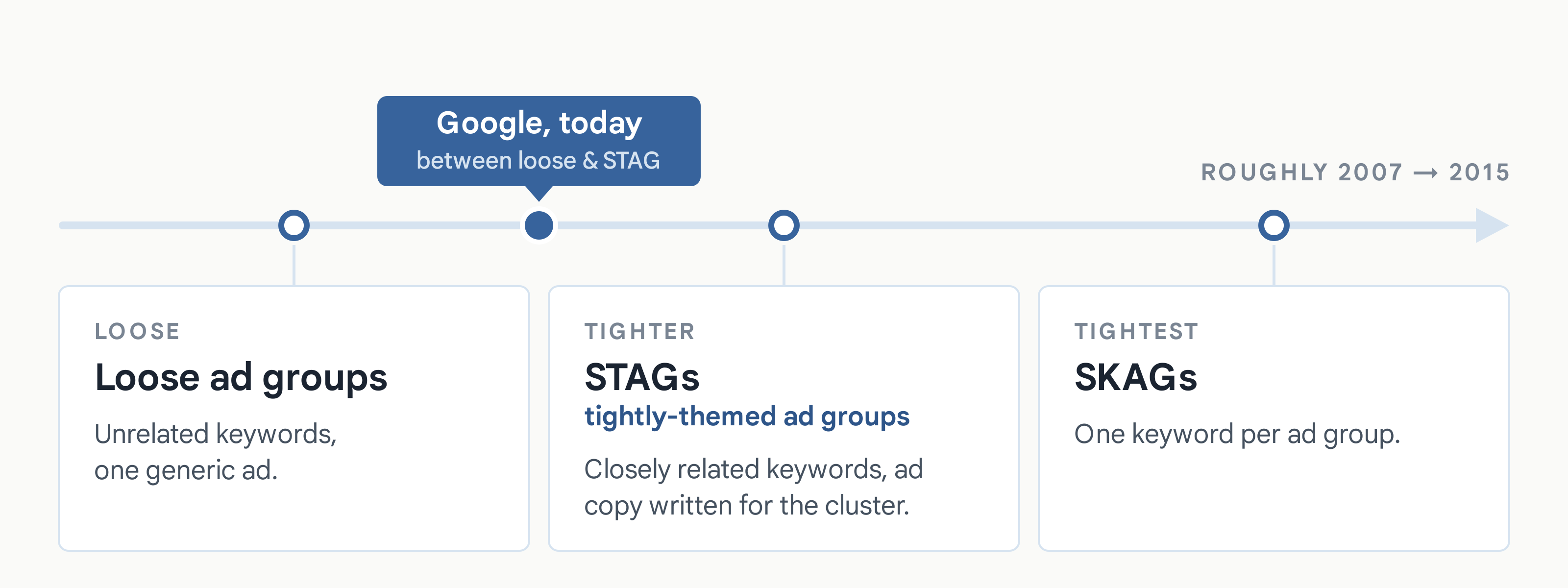
On the scale, the industry spent more than a decade moving right, toward one keyword per ad group. Google’s current advice puts you back over here, and the unit isn’t the keyword anymore. It’s the landing page and the message.
The argument, checked
Google doesn’t just assert this. It gives you a worked example, and it’s worth going through carefully, because it’s the evidence behind the no SKAGs recommendation.
The target CPA is $10:
| Split: exact | Split: broad | Consolidated | |
|---|---|---|---|
| Campaign | Shoes | Shoes | Shoes |
| Ad group | Running shoes, exact match | Running shoes, broad match | Running shoes |
| Keyword | [running shoes] | running shoes | running shoes |
| Marginal CPA when average CPA = $10 | $14 | $11 | $12.50 |
The charts put numbers on it. Split, a hundred conversions. Consolidated, a hundred and ten.
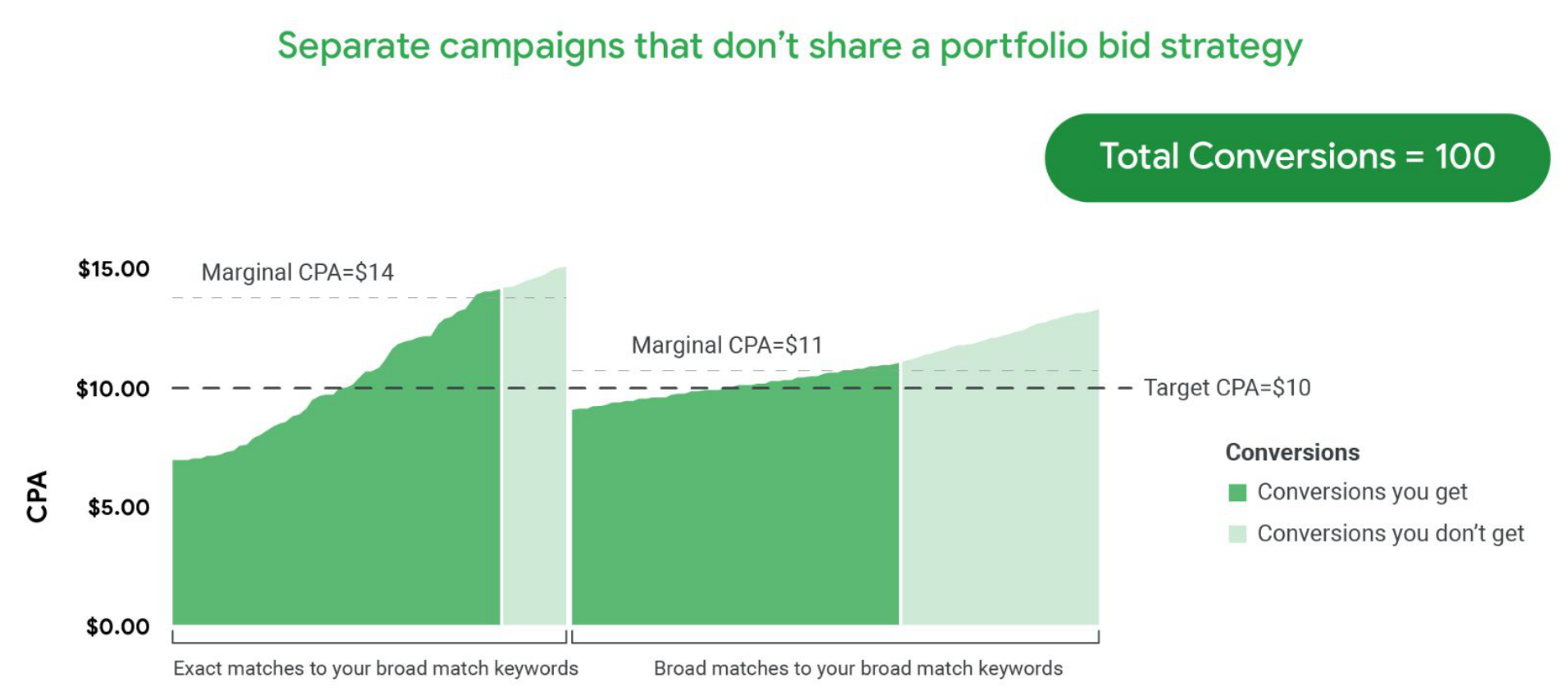
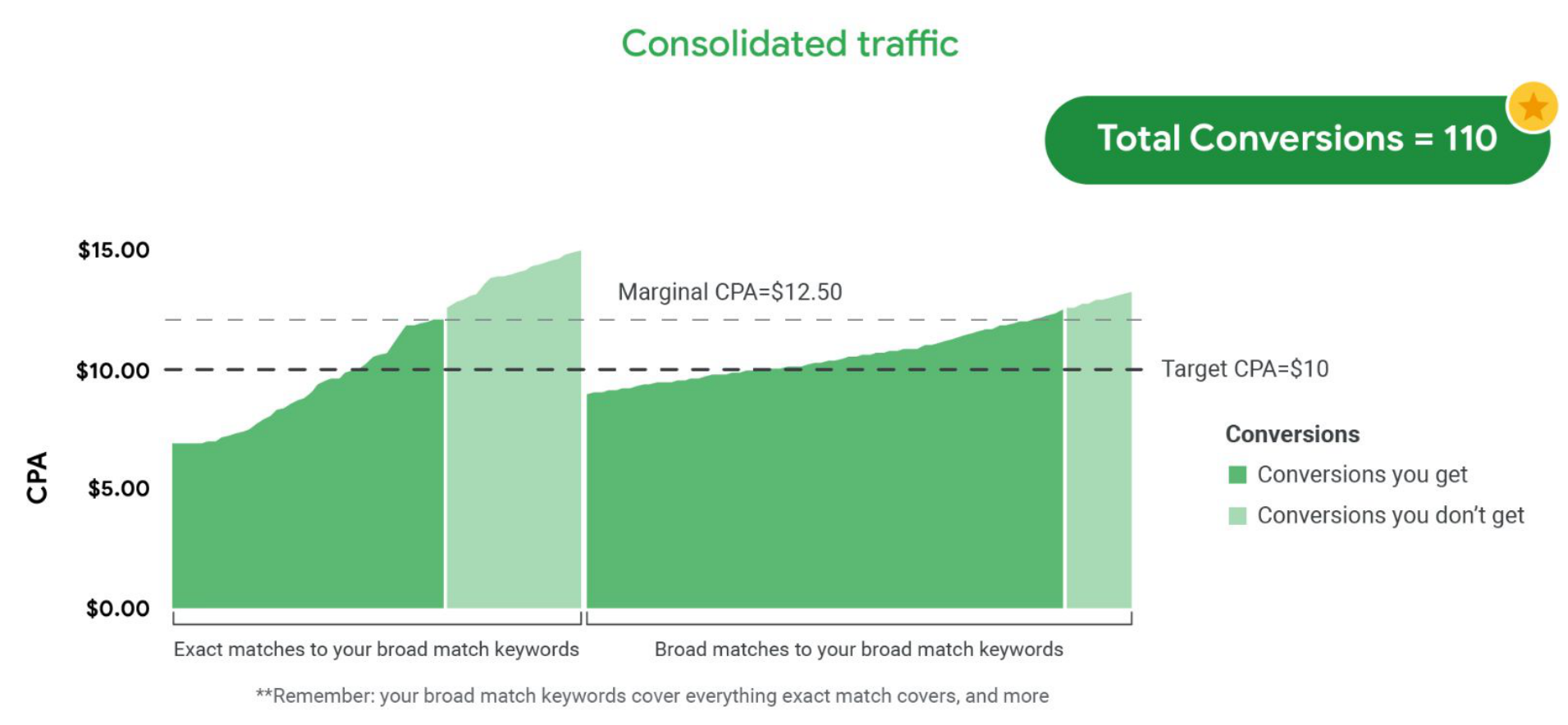
The logic is about efficiency. If part of your account is forced to buy expensive conversions while cheaper ones sit unbought somewhere else, you end up with fewer conversions for the same budget. Consolidating is supposed to let the bidding system buy the cheaper ones first.
Whether that plays out in a given account is a bidding question, and bidding gets its own post. What I can do here is look at how Google presents the evidence. Four things.
-
It’s an illustration, not a result. Every other statistic in that guide carries a source line. This one doesn’t, and the text says Smart Bidding might set $12.50 and the split could force $14 and $11.
-
The table and the chart describe different setups. The table shows two ad groups inside one campaign. The chart is titled separate campaigns that don’t share a portfolio bid strategy. Those aren’t the same situation.
-
Google names its own fix elsewhere in the guide. The problem it describes is traffic split across campaigns that don’t share a portfolio bid strategy, and a portfolio strategy can be applied across campaigns.
-
Look at where the no SKAGs sentence sits. The paragraph it closes is about splitting traffic by match type, exact in one ad group, broad in another, and it explains why that forces the bidding system to hit your target separately in each one. Then it ends with “this is why we don’t recommend single keyword ad groups.”
But a single keyword ad group with one broad keyword isn’t split by match type. There’s only one keyword in it. The argument in that paragraph doesn’t describe it.
What the argument does describe loosely is the Alpha Beta structure, where you deliberately separate your proven exact match terms from your broad discovery terms. That’s the thing being argued against. SKAGs got named at the end of it.
The ABCs page has the same condition written into it. Its example of three device campaigns becoming one carries an asterisk: “When using Smart Bidding.” And the match type advice says:
“There’s no additional benefit to having multiple match types if you’re using Smart Bidding.”
Every part of this case is conditional on Smart Bidding. If you’re running manual CPC, Google’s own reasoning for consolidating doesn’t apply to you. That’s not my argument, it’s theirs.
The control map
Rather than memorizing best practices, it’s easier to know what each level of the account actually decides. Then structure follows from that.
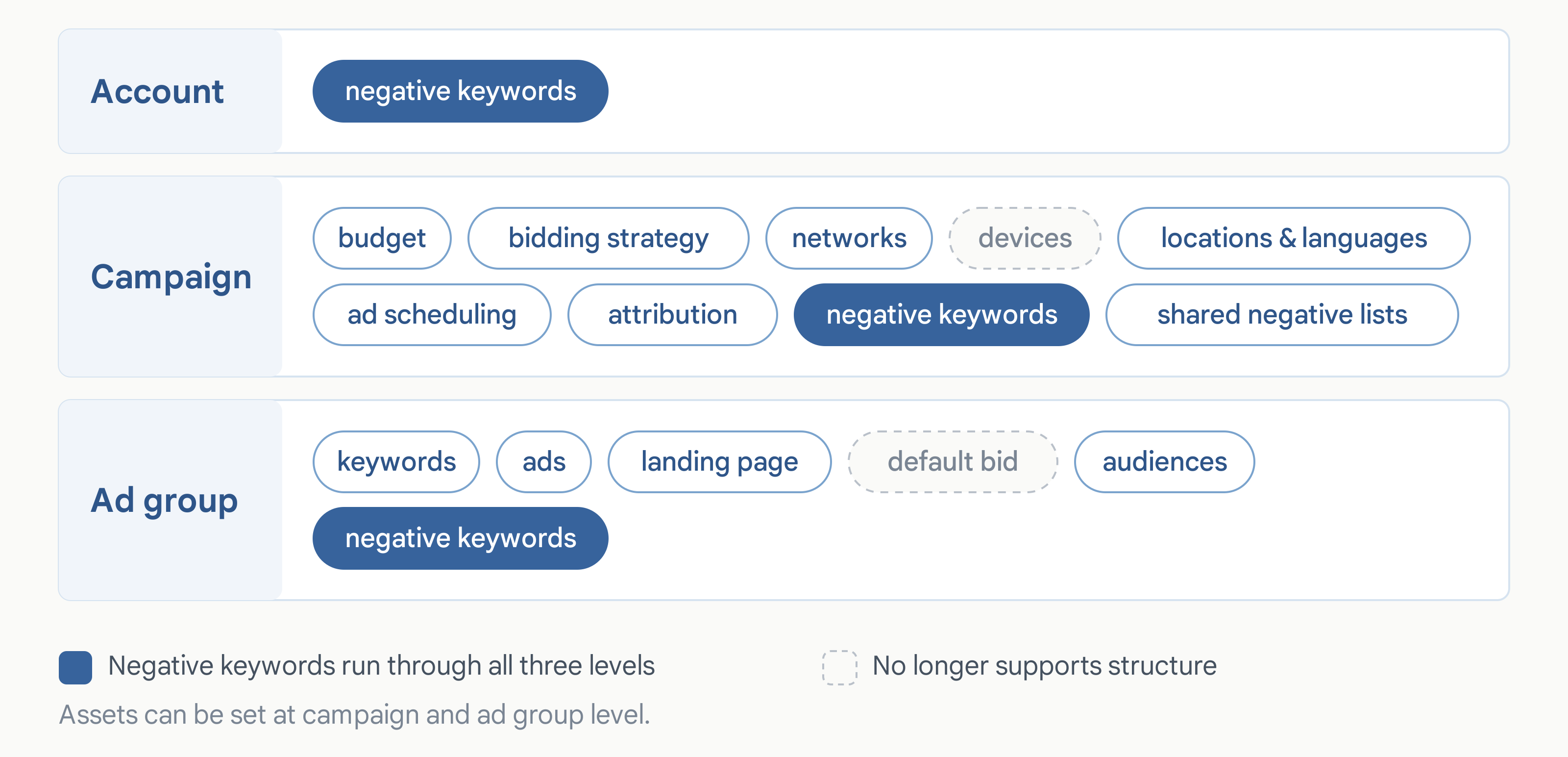
- At the account level, negative keywords.
- At the campaign level: your budget, your bidding strategy, networks, devices, locations and languages, ad scheduling, attribution, negative keywords, and shared negative lists.
- At the ad group level: your keywords, your ads, your landing page, your default bid, audiences, and negative keywords.
Assets can be set at both campaign and ad group level.
Negatives are the one thing that runs from the account all the way down to the ad group. I covered those in detail in the negative keywords post.
The rule falls out of the map. If two groups of keywords need a different budget, a different bidding target, or different locations, they need separate campaigns. If they need a different landing page or different ad copy, they need separate ad groups.
Geography is the clearest example. Location targeting is a campaign setting. So if you want to advertise different services in different service areas, that’s separate campaigns, no debate.
Two things on that map exist but don’t support structure anymore. Device adjustments, which Google tells you to remove. And keyword level bids, which don’t do the same job once you’re on automated bidding.
One note before we finish. All of this is about Search campaigns. Performance Max is built differently, with asset groups instead of ad groups and search themes instead of keywords, so its structure rules are different. That gets its own post.
What’s settled, and what isn’t
What’s settled is more than you’d think from the arguing online. Campaigns split by objective, budget, and geography. Ad groups built around a landing page and a message. Single keyword ad groups don’t make sense anymore, and the clearest reason isn’t Google’s recommendation at all, it’s that the keyword-level control SKAGs were built around isn’t really there anymore.
What isn’t settled is how wide a theme should go. Google’s own examples don’t agree with each other. The ABCs page collapses men’s shirts and men’s pants into men’s clothing. Another Google page uses ad groups with two keywords each and their own specific landing page. There’s no number anywhere in the documentation, and the only test Google gives you is whether the keywords share a landing page and a message.
And the consolidation argument has a wrinkle worth sitting with. It’s strongest for accounts with very few conversions, because those are the accounts where splitting the data hurts most. Those are also the accounts with the least budget to absorb broad match waste. So the advertisers who stand to gain most from Google’s advice are the ones who can least afford to find out it doesn’t work for them.