Google Ads Match Types in 2026: What Broad, Phrase, and Exact Actually Do
If you’ve been running Google Ads over the past several years, you’ve probably had this thought: are keywords and match types still the foundation of PPC, or am I wasting my time on them?
It’s a fair question. Google has spent the last few years telling everyone to use broad match and let the system figure it out. And a lot of advertisers have quietly stopped believing that match types mean very much anymore.
So this is a definitions post. Broad, phrase, exact, and what each one actually does today.
The names never changed. The definitions underneath them did. And once you really look at how far they’ve moved over time, a lot of what used to be standard practice stops making sense.
What a keyword used to be
Originally, a keyword was a gate of sorts.
You bid on a string of text. That string had to appear in the user’s search. If it didn’t, you weren’t in the auction. That was the whole contract, and it was close to mechanical. You decided which searches you were willing to pay for, and Google honored the list.
That’s what exact match meant. You put brackets around the term, and your ad showed on that term and nothing else. Not the plural. Not any misspellings or slight variations. Just that term.
Two decades of moving that line:
| Year | What changed |
|---|---|
| 2000 | AdWords launches. Self-service keyword advertising arrives. |
| 2002 | The CPC relaunch. Cost-per-click AdWords ships with exact and phrase match. |
| 2006 | Broad match. Ads begin reaching related searches, not just the typed words. |
| 2010 | Broad match modifier. A +word syntax to pin down required terms. |
| 2012 | Close variants introduced, with an opt-out. |
| 2014 | Close variants become mandatory on exact match. The opt-out is gone. |
| 2021 | BMM folded into phrase. Broad match modifier retires; phrase absorbs it. |
That 2014 change is where the definition started drifting, and it never stopped. Here’s the setting while it still existed:
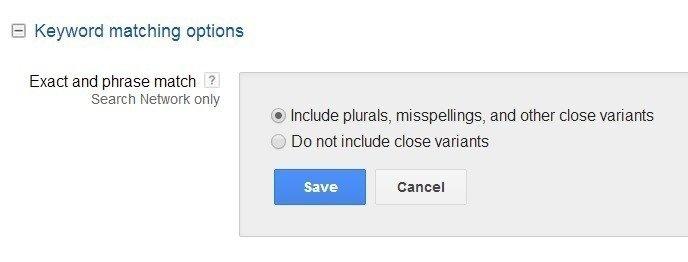
At the time, I was running a large account in a niche we effectively owned, the most profitable I’ve ever worked in. We had years of harvested search query data, exact match keywords in single keyword ad groups, tightly written ad copy for each one. We scaled it for years by pulling new queries out of BMM and breaking them into exact match single keyword ad groups, or SKAGs. It spent and made millions of dollars in not only revenue, but profit as well.
Then one day I noticed the same search query matching to multiple keywords in my own account.
That might sound like a small thing. It wasn’t. The entire structure assumed one query would match to one keyword. That was how I controlled the bid and the ad copy for every search we paid for. When that stopped being true, I couldn’t reason accurately about my own account anymore.
That whole account structure rested on the assumption I just described: one query matched to one keyword. Google now recommends against building campaigns that way, and they give a specific reason, which I’ll get into in a later post on account structure.
The three match types today
I’ve written about match types several times over the years, but everything below comes from Google’s current documentation rather than from memory.
Broad match
Broad match is the default. No punctuation delimiters, just the keyword typed in.
Google’s definition is that your ads may show on searches related to your keyword, and they say explicitly that this can include searches which don’t contain the direct meaning of your keyword. Not searches that don’t contain your words. Searches that don’t contain your meaning.
Their own example is a keyword for low-carb diet plan matching a search for mediterranean diet books. Those are different diets.
Or take their landscaping example. The keyword is lawn mowing service. Broad match will pick up grass cutting service near me, local lawn cutting services, and lawn aeration prices. Only one of those shares a word with your keyword.
How broad match decides
Google published a technical guide on keyword matching, and there’s something in it worth understanding, because it changes how you think about your own search terms report.
Step one of the process isn’t matching your keyword to the search. Step one is the system reading the user’s input and building what they call a retrieval query, using spell corrections, synonyms, and related concepts. That constructed query is then used to pull your eligible keywords.
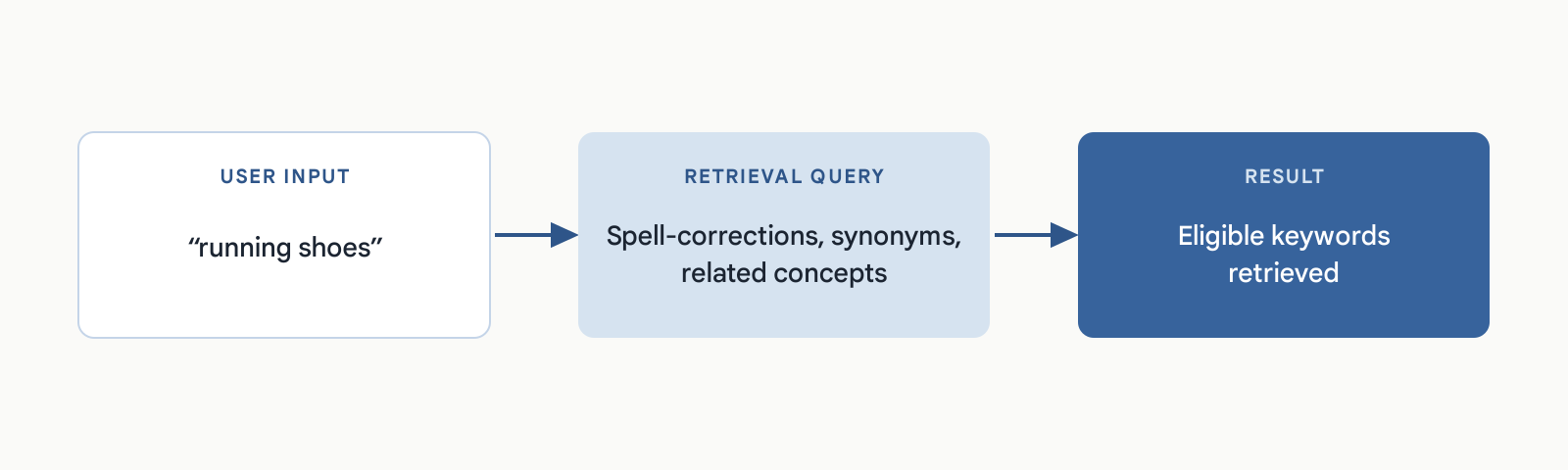
So there’s a translation layer before matching happens at all. The thing your keyword gets compared against isn’t what the user typed. It’s Google’s interpretation of what the user meant.
That explains something a lot of people find confusing about the search terms report. You aren’t looking at a transcript. You’re looking downstream of an interpretation.
In the same guide, Google states that for keyword eligibility they use machine learning and natural language understanding technologies like the BERT language model to understand the intent behind queries. That’s one of the very few places they say anything specific about the technology.
The four signals
Broad match doesn’t just look at the search. It looks at four other things.
| Signal | Google’s example |
|---|---|
| Other keywords in your ad group | Keyword is pink socks, search is salmon socks. Because the ad group also contains red socks and blue socks, the system works out that salmon is a color, not a fish. |
| The user’s previous searches | Keyword is chicago vs ny baseball, search is chicago vs ny. Their prior searches were about baseball scores, so the system fills in what they meant. |
| The user’s location | Keyword is restaurants in NY, search is restaurants near me, user is in New York. |
| Your landing page | Keyword is shoes. Search is a specific product name the keyword never mentioned. Google reads the landing page, finds that you sell that product, and matches anyway. |
The last one is worth sitting with. Your landing page isn’t just where the click goes. It’s an input into which searches you’re eligible for. What you write on that page is doing targeting work in a way that it never was in earlier incarnations of Google Ads.
That opens up a lot of ideas worth giving serious consideration to.
Google also says broad match is the only match type that uses all of the available signals. Exact and phrase match have to satisfy additional matching requirements, so they’re restricted from using those signals.
Many advertisers will tell you they don’t trust Google’s matching. They fear losing control of where the money goes when Google is given free reign over what queries to match their ads against.
You can run broad match on manual bidding. But that’s really only an illusion of control. One bid, applied to a query set you can’t see ahead of time. You’re setting a price without knowing what you’re buying.
One more thing, because it becomes important at the end. Google’s guidance is that it’s critical to use Smart Bidding with broad match, because every query is different and the bid should reflect the signals available at auction time.
Phrase match
Phrase match has quotation mark delimiters around the keyword.
When phrase match was first introduced, and for many years after that, a phrase match keyword would only match a search query that contained that exact phrase, with no words in between, and additional words either before or after but not between.
Over time the criteria relaxed to include close variations: misspellings, singular and plural forms, acronyms, stemmings such as floor and flooring, abbreviations, and accents.
Today, Google’s language is that ads may show on searches that include the meaning of your keyword. The meaning can be implied. And the user’s search can be a more specific form of that meaning.
So the phrase no longer has to appear intact, and words can land in the middle of it. It’s about meaning now, not about the string.
But word order hasn’t disappeared entirely, and this is the part people get wrong in both directions.
| Keyword | Matches | Doesn’t match |
|---|---|---|
"moving services NYC to Boston" |
affordable moving services NYC to Boston NYC corporate moving services to Boston |
moving services Boston to NYC |
That second match used to require broad match modifier. The one it won’t show for is the reversal, because swapping those two cities changes what the person actually wants.
So word order isn’t the hard rule it used to be. But it still applies where the order changes the meaning.
And this is where broad match modifier went. In 2021, Google folded BMM into phrase match, and phrase absorbed a chunk of what broad used to do.
Exact match
Exact match uses square bracket delimiters. And as covered above, exact match stopped being purely exact back in 2014.
Google’s language today says ads may show on searches that have the same meaning or the same intent as your keyword. The same meaning. The same intent. But not the same words. Their example, [shoes for men], matches shoes for a man and men shoe. It doesn’t match mens tennis shoes.
One specific word choice in the documentation is worth pointing at. Google says that of the three options, exact match gives you the most steering over who sees your ad.
Steering. Not control. Somebody chose that word carefully, and it’s accurate.
They aren’t three things
The line that pulls all three together sits at the top of Google’s matching options page, where most people scroll past it.
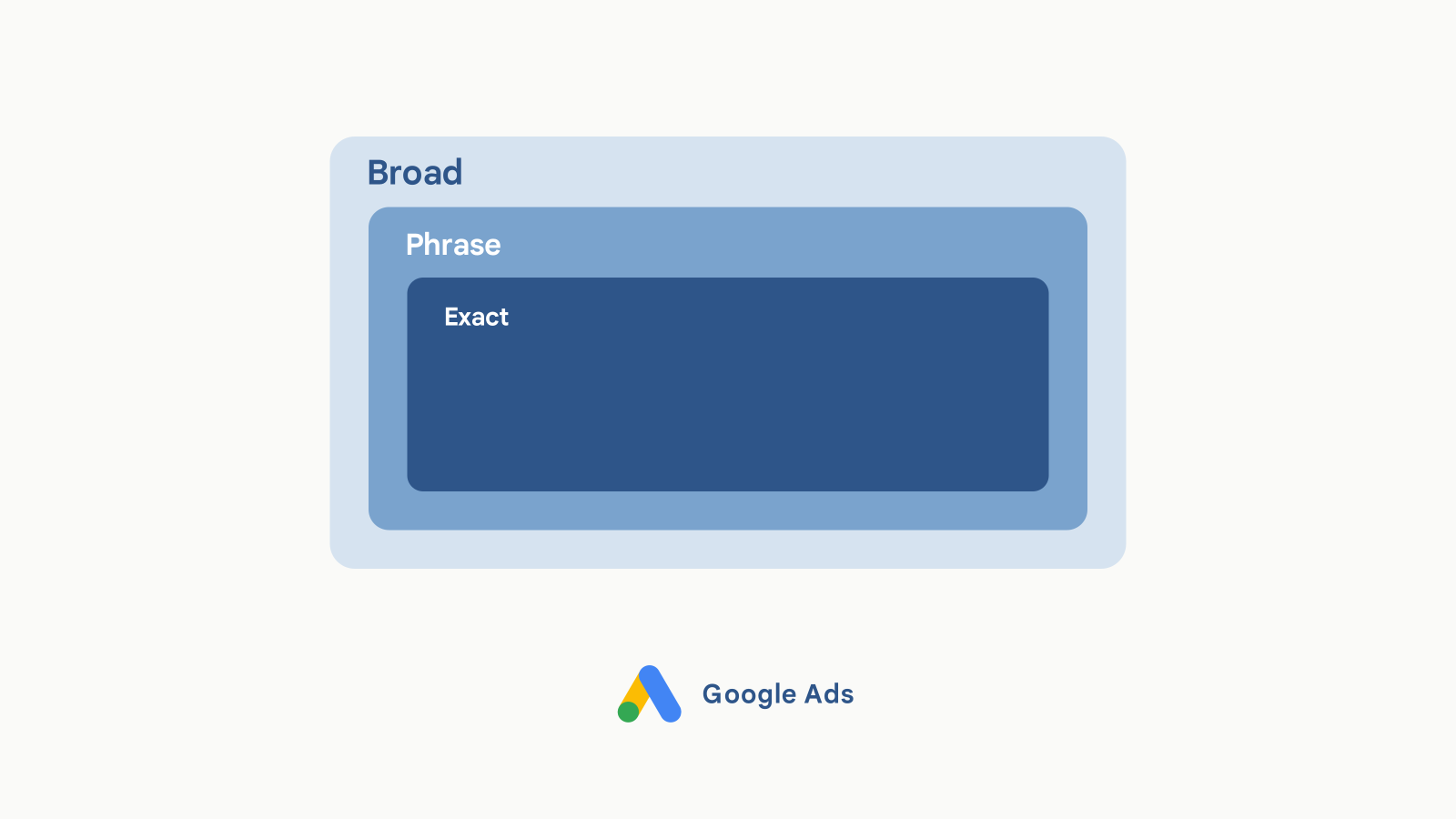
Google says that broader match types capture all the queries of narrower match types, plus more. A phrase match keyword will match everything the same keyword in exact match would match. A broad match keyword will match everything phrase and exact would, plus additional related searches.
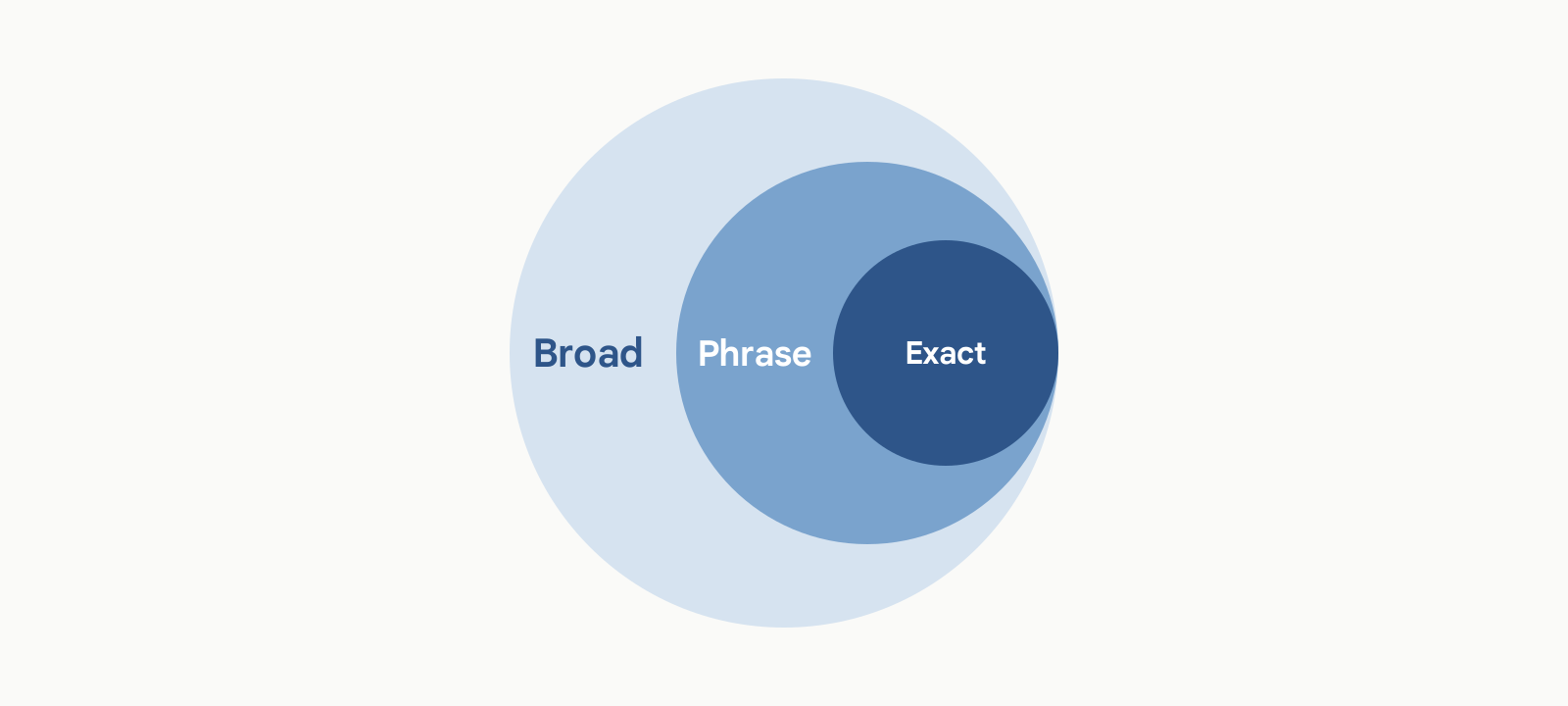
That’s a containment hierarchy. They aren’t three different kinds of matching. They’re three settings on one dial, and the dial controls how loosely the system is allowed to interpret you.
All three match on meaning now. The only thing that varies is how far from your keyword the system is permitted to travel.
To be fair about what Google does with that fact, because they say it right there: their conclusion is that you get the benefits of multiple match types in one broad match type, so you don’t need to repeat keywords. Use broad, skip the rest.
That follows logically. But the same fact supports a different conclusion.
What actually changed
Three documented mechanics together explain what happened to your control.
The asymmetry
Positive and negative keywords don’t behave like mirror images.
| Positive keywords | Negative keywords |
|---|---|
| Expand on their own. Broad, phrase, even exact reach beyond the exact words you typed, and there’s no switch to turn that expansion off. | Stay literal. They block only the terms you actually list. They don’t automatically catch close variants, synonyms, or related searches. |
If you add jobs as a negative, it doesn’t block job. Google’s own documentation tells you to add the plurals and the synonyms yourself.
So expansion is automatic and has no ceiling, and restriction is manual and literal. That’s the shape of the system. That asymmetry gets its own post.
What “identical” actually means
Exact match keywords do get priority. If a user’s search is identical to your exact match keyword, that campaign is prioritized over broad and phrase keywords and over Performance Max.
But look at the footnote defining identical. It includes spell-corrected search terms. It doesn’t include plurals or synonyms.
So your exact match keyword only gets that priority protection on a much narrower set of queries than most people assume. Outside of that, you’re back in the general pool with everything else.
Where the keyword stops deciding
This one is buried in an exceptions list at the bottom of a help page.
Google says that for more complex search journeys, and it names Lens, AI Mode, AI Overviews and autocomplete searches, the search term you see in your reporting is the best approximation of the user’s intent. And because those searches aren’t technically identical to a keyword, keywords may not automatically be prioritized. Instead, AI-based ad group prioritization picks the most relevant ad group.
Two things are being conceded there.
One, in the surfaces where search is heading, the keyword priority system above doesn’t apply. The AI decides which of your ad groups is most relevant.
Two, the search term in your report is a reconstruction. It’s Google’s approximation of what the user meant, not a transcript of what they typed.
A keyword used to be a gate. Now it’s a signal. It no longer decides whether you’re in. It’s one input among many that Google weighs to decide which auctions you belong in.
What the data says
That’s the official picture. Here’s what advertisers are actually doing, and what it’s getting them.
In May 2026, Optmyzr published a study of 30,000 Google Ads accounts using February data, covering non-branded Search campaigns with active keyword spend. These are their own customers, so it isn’t a random sample of every advertiser on the platform. But it’s 30,000 accounts, which is more than any of us are looking at.
Since 2022, exact match has lost nine and a half points of spend share. Broad has climbed to become the dominant match type by budget. Phrase dipped in 2024 and has been recovering through 2026.
So advertisers are moving money toward broad. That isn’t a small drift, that’s a real shift in behavior.
The second finding is the one that gets quoted: across all account types combined, exact match still leads on efficiency. Their reasoning is that a keyword sitting close to the typed query carries a cleaner intent signal, so the ad fits better and the click converts more often.
Which sounds like a contradiction. Advertisers are moving budget away from the match type that leads on efficiency, in favor of the one that leads on expansion and that Google is recommending more people use to the exclusion of the others.
The aggregate hides the part that matters to you
They broke it out by account type. Ecommerce accounts, meaning accounts with measurable conversion value. And lead gen accounts, meaning accounts without revenue tracking, which is most contractors, most professional services, and most B2B.
In lead gen, the picture is different. Phrase takes the biggest slice of both spend and conversions, and by a wider margin than anywhere else in the study. Broad is the one that slips.
Their read on why: when Smart Bidding has no conversion value to learn from, it has thinner signal to work with, and broad match is the match type most dependent on that signal being good.
So if you run lead generation, the headline isn’t that exact match wins. It’s that phrase match is doing the heavy lifting, and broad match is weakest.
One more finding worth knowing if you run brand campaigns. On branded terms, exact match leads on nearly every metric. The only exception is conversion rate, where phrase edges it by four hundredths of a point, 8.22% against 8.18%.
Two things to be careful about
Before you take the exact match efficiency number to the bank, two caveats. These are mine, not the study’s.
First, exact match has been redefined at least three times since 2014. So when you compare exact match performance across a span of years, you’re comparing different things that happen to share a label.
Second, think about how a keyword ends up in exact match. Usually you found it somewhere looser, it converted, and you promoted it. Exact match ad groups are stocked with terms that have already been proven. So part of exact match’s efficiency advantage is measuring your own curation, not the precision of the matching.
Google agrees on this one, which surprised me. In their keyword matching guide, they say comparing broad match used to find new queries against exact match holding queries you already know will perform isn’t an apples-to-apples comparison.
That’s Google and a third-party study arriving at the same caution from opposite directions.
Follow the chain
There’s a chain here, and it decides everything.
The old complaint about broad match was that it wasted money on irrelevant queries. That was true. It was often the case with accounts I’ve managed, although in varying degrees.
- Broad match’s answer to losing control is Smart Bidding. Google isn’t soft about this. Their own documentation says it’s critical to use Smart Bidding with broad match, because the bid has to change per query.
- Smart Bidding’s answer to bidding well is conversion data. Their guide puts it plainly: the machine learning algorithm is only as good as what it’s given to learn.
- Most lead gen advertisers don’t have enough of it, due to volume constraints. Or often, the conversion data is imprecise because tracking is poorly set up, or because of the longer nature of the customer journey or sales cycle.
That’s why the Optmyzr numbers look the way they do. Broad match is a bet on the algorithm, and the conditions have to be there. In lead gen they frequently are not.
So the honest answer to should I use broad match isn’t yes or no. It’s: how good is your conversion tracking, and are you optimizing toward something that reflects actual business value?
Which brings us back to where we started.
Keywords haven’t gone away. They still bid, they still report, they still carry priority, they still tell the system what you’re about. What they stopped doing is deciding which searches you show for.
The foundation moved. And it moved down into your data.