AI Max, and Who Writes the Ad Now
At the end of the last post I said your landing pages aren’t just where traffic arrives anymore. Google reads them to decide which searches you’re eligible for in the first place.
There’s a feature built entirely around that idea. Google reads your site, picks which page to send each search to, and writes the ad itself.
It’s called AI Max, and if you’ve created a Search campaign recently, you may already be using it. From Google’s setup page:
New Search campaigns have the AI Max feature turned on by default.
And from its guide to broad match:
Broad match is the default match type for all keywords.
Here’s how Google describes AI Max:
AI Max offers a comprehensive suite of targeting and creative enhancements–including improved search term matching, better text customization of your headlines and descriptions, and final URL expansion to increase the relevancy of your landing page to a user’s intent.
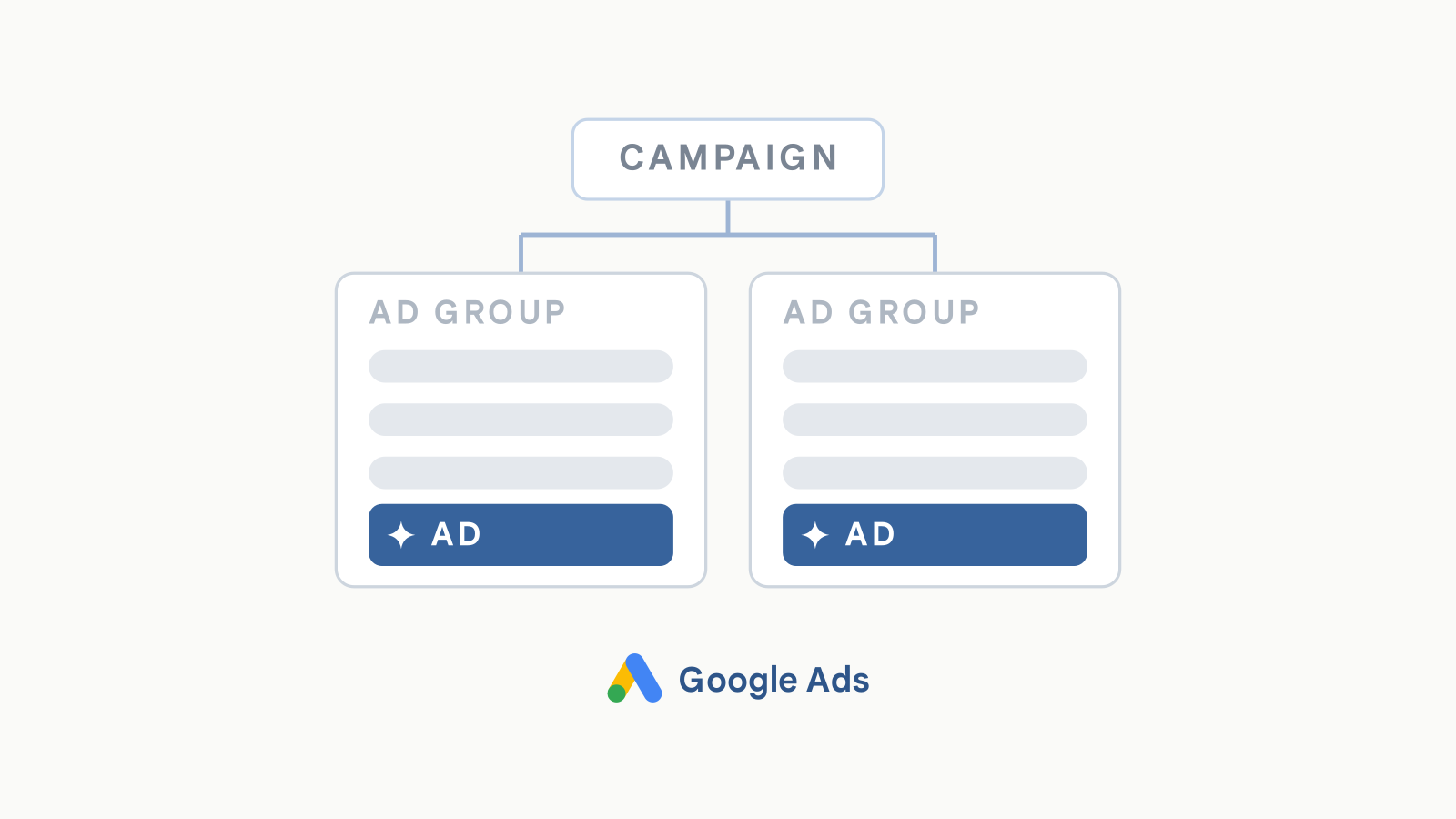
It isn’t a campaign type. It’s a set of switches inside a regular Search campaign, sitting on top of the structure you already built.
The work that made SKAGs valuable, lining up the keyword, the ad, and the page so the searcher got exactly what they asked for, is being automated. What isn’t automated is having pages worth matching to in the first place.
Final URL expansion
Start with the problem from the last post.
You’ve got one ad group. Its ads point at one final URL. So if you widen that ad group, say you put Asics and Hoka keywords in the same running shoes group, every search lands on the same page. That’s the practical limit on how wide an ad group can go.
Final URL expansion is the answer to that, and the way Google words it matters:
Final URL expansion will only send traffic to URLs that are query relevant and themed to your ad group.
So Google picks the page, but not from anywhere on your site. It picks within your ad group’s theme. Somebody searches Asics, they get the Asics page. Somebody searches Hoka, they get the Hoka page. Same ad group.
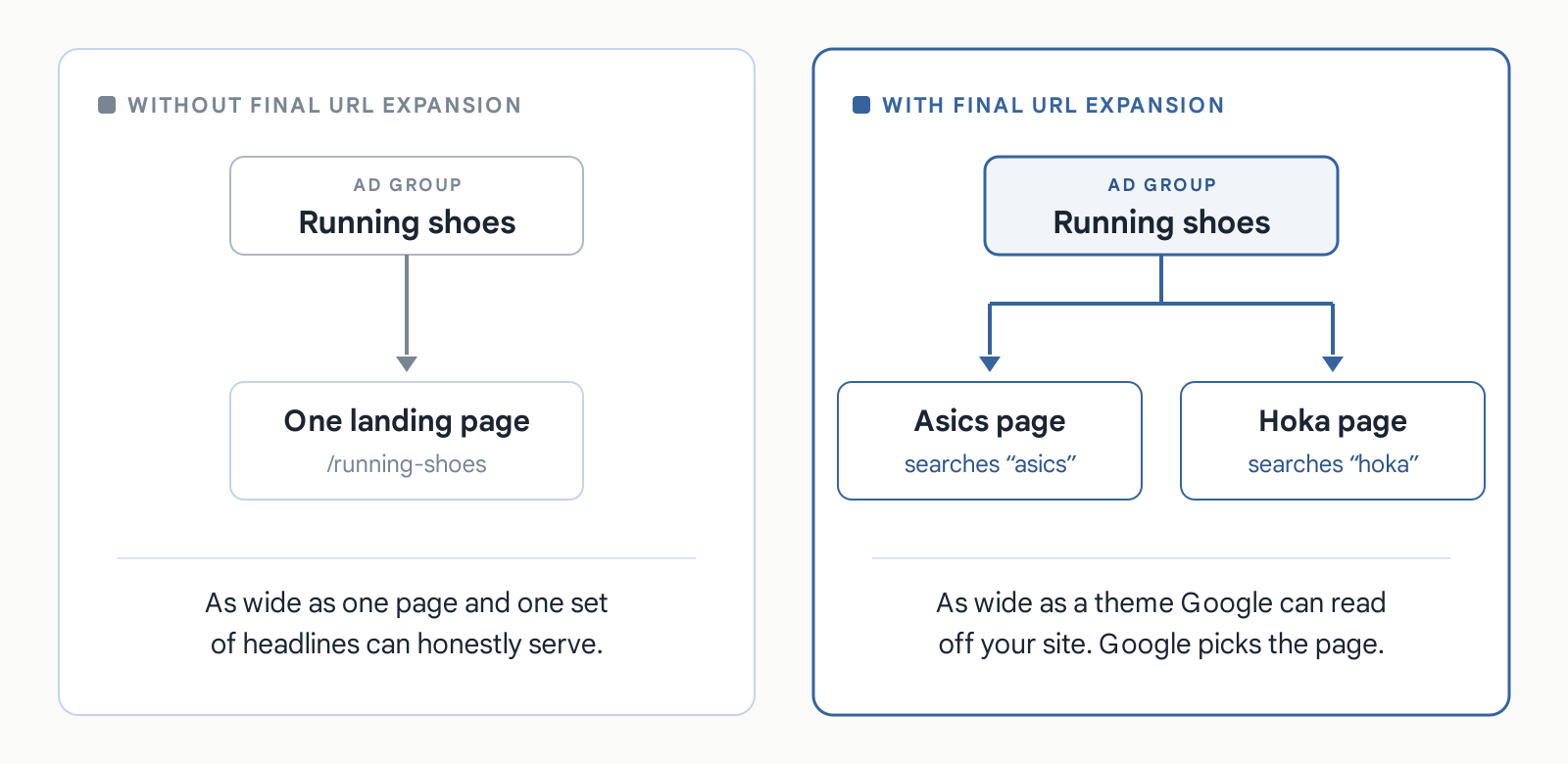
That changes how wide an ad group can be.
Without final URL expansion, an ad group is as wide as one landing page and one set of headlines can honestly serve. That’s the test from the last post.
With it, an ad group is as wide as a theme Google can read off your site, and Google chooses which page each search lands on.
Both still depend on the theme. Google’s own wording says themed to your ad group. So this isn’t structure disappearing. It’s structure doing a different job.
You get two controls over it. URL exclusions at the campaign level, to keep Google out of parts of your site. And URL inclusions at the ad group level, to restrict expansion to specific pages.
Which makes your website part of your targeting.
Every page Google can crawl is potential inventory. The thin service page you wrote in 2019 and forgot about is eligible. The careers page. The old promotion. If you don’t exclude it, it’s in the pool.
Google’s own comparison
Google illustrates this with three panels. The search is “best serum for dry sensitive skin.” On the left, a regular Search ad: Shop Our Skin and Hair Care Line, Get Ready to Turn Heads, with copy about the entire product range for all skin types. In the middle, keywordless technology: Face Serum for Dry, Sensitive Skin, with copy about exactly that. On the right, final URL expansion finding the product page instead of the general one.
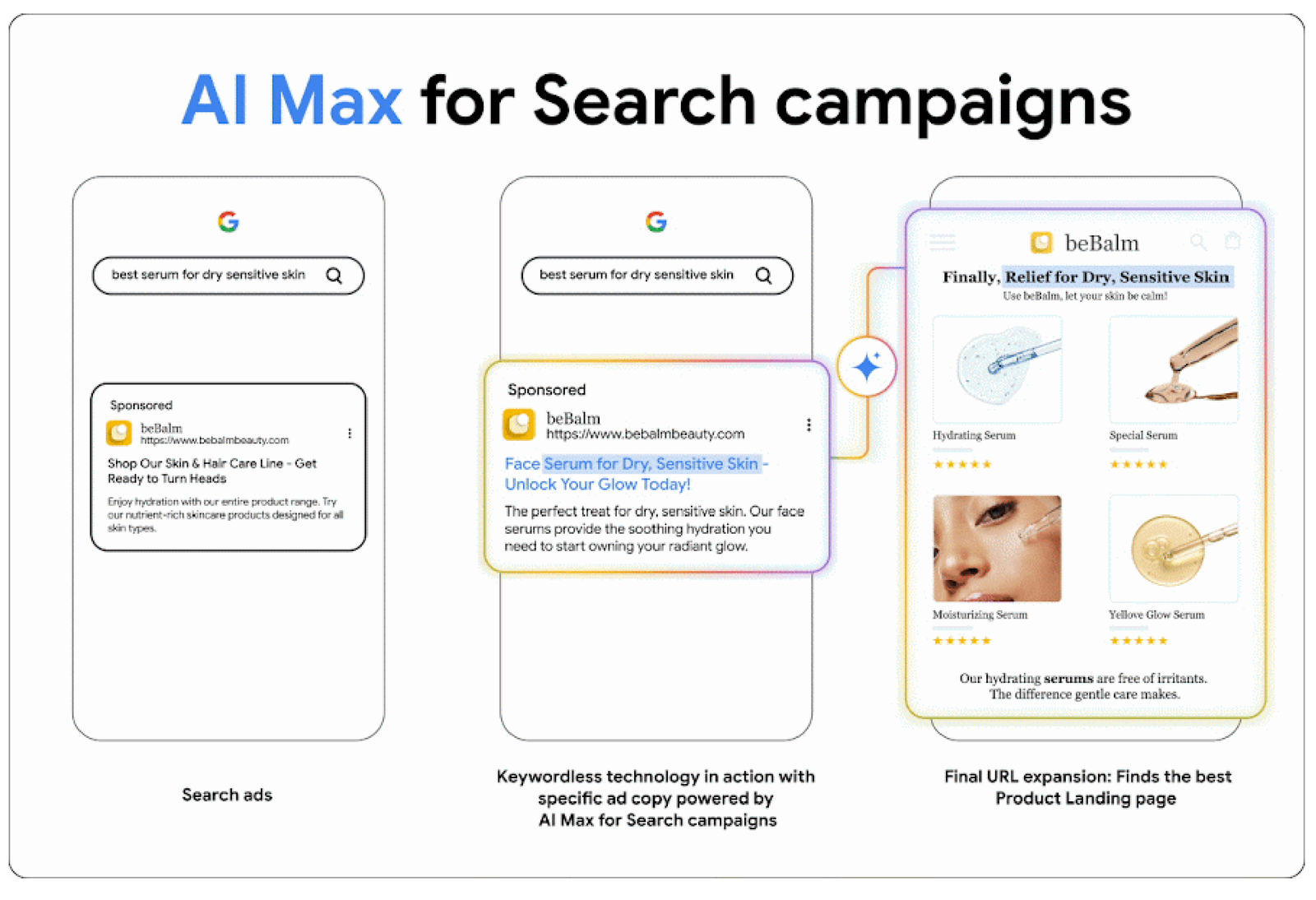
That comparison is doing some work for Google, and it’s worth naming.
The ad on the left isn’t what a good advertiser used to do. It’s what a lazy or new advertiser who wasn’t aware of how to properly structure a campaign did. Somebody running SKAGs in 2014 would have written that middle headline themselves. They’d have had an ad group for dry sensitive skin serum, an ad with that exact phrase in the headline, and a link straight to the serum page. That was the whole method—aligning the user’s query to the ad to the landing page.
| Google’s “before” ad | What a SKAG advertiser wrote by hand | |
|---|---|---|
| Headline | Shop Our Skin & Hair Care Line – Get Ready to Turn Heads | Face Serum for Dry, Sensitive Skin |
| Description | Enjoy hydration with our entire product range, for all skin types. | Soothing hydration for dry, sensitive skin. |
| Ad group | — | dry sensitive skin serum |
| Links to | — | /serums/dry-sensitive |
So AI Max isn’t beating a well-built account here. It’s beating an unstructured one.
The real difference is somewhere else. The old way could line things up perfectly for the queries you anticipated. You sat down, built your list, wrote the ads. This does it for queries you never thought of, at a scale no person could match by hand.
Google writes the ad
Final URL expansion picks the page. Text customization writes the ad to match it.
Google’s FAQ describes it in three steps:
- AI Max improves your creatives by identifying marketing messages from your URLs that would be relevant to the user’s query.
- It then writes assets that complement your campaign and existing ads.
- Finally, the assets are composed into an ad and sent as a candidate into auction.
Asked whether you can create, edit, or customize those assets, Google’s answer is no:
No, these assets will fully be automated.
And pinning doesn’t save you:
If you’ve enabled both text customization and final URL expansion settings, pinning of RSA assets will not be respected. Additionally, pinning is not respected when URL inclusions are provided.
Perry Marshall’s advice in 2007 was to take your keyword and stick it into the headline of your ad. You controlled the headline, so you controlled how relevant the ad looked. This was in response to Google’s rollout of the Quality Score in 2005, which penalized ads that were not relevant to the user’s search query.
Pinning is the modern version of that control. Google now writes the headline, and if it picks a different page than the one your ad pointed at, it ignores your pin.
Google does say the new ad may include your existing ad copy:
Yes, the new ad may include your existing ad copy if it’s relevant to the user’s query and ad URL. The new ad content reflects the marketing messages from your URLs.
So your copy is an input. It isn’t the output.
What you still control
You’re not without controls. They’re a different kind of control than writing an ad.
Text guidelines, currently in beta, let you set up to 25 term exclusions and up to 40 messaging restrictions per campaign.
Term exclusions are words Google can’t use. Messaging restrictions are rules about what the copy can claim. If you can’t legally say guaranteed, that’s a term exclusion. If you don’t do emergency work, that’s a messaging restriction.
You also get brand inclusions and exclusions, you can remove generated assets after the fact, and locations of interest can be set at the ad group level.
And negative keywords still work. Google’s FAQ:
Does AI Max honor negative keywords?
Yes. Negative keywords will be respected even with AI Max turned on.
In the account structure post I showed this pattern with devices and with bidding. You do the thing yourself. Then Google gives you controls that replace doing it yourself. Then Google does it, and gives you boundaries.
| Stage 1: You do it | Stage 2: You set controls on it | Stage 3: Google does it, you set boundaries | |
|---|---|---|---|
| Devices | Separate campaigns per device | Device bid adjustments | Automated device optimization |
| Bidding | Manual CPC | Bid rules & strategies | Smart Bidding to a target |
| Ad copy | Write every ad | RSA + pinning | Text customization + text guidelines |
Ad copy is now in that third stage. You used to write the ad. Now you write the rules the ad has to follow.
What happens to the SKAG
Google’s FAQ says:
If you add a standard ad-group with at least one broad match keyword, the ad-group gets keywordless recall.
Keywordless means Google can match searches to that ad group without going through your keywords at all, using your landing pages and your assets instead.
So picture a single keyword ad group inside an AI Max campaign. One broad keyword. That ad group can serve searches that have nothing to do with the words in that keyword, because the matching isn’t running on the keyword anymore.
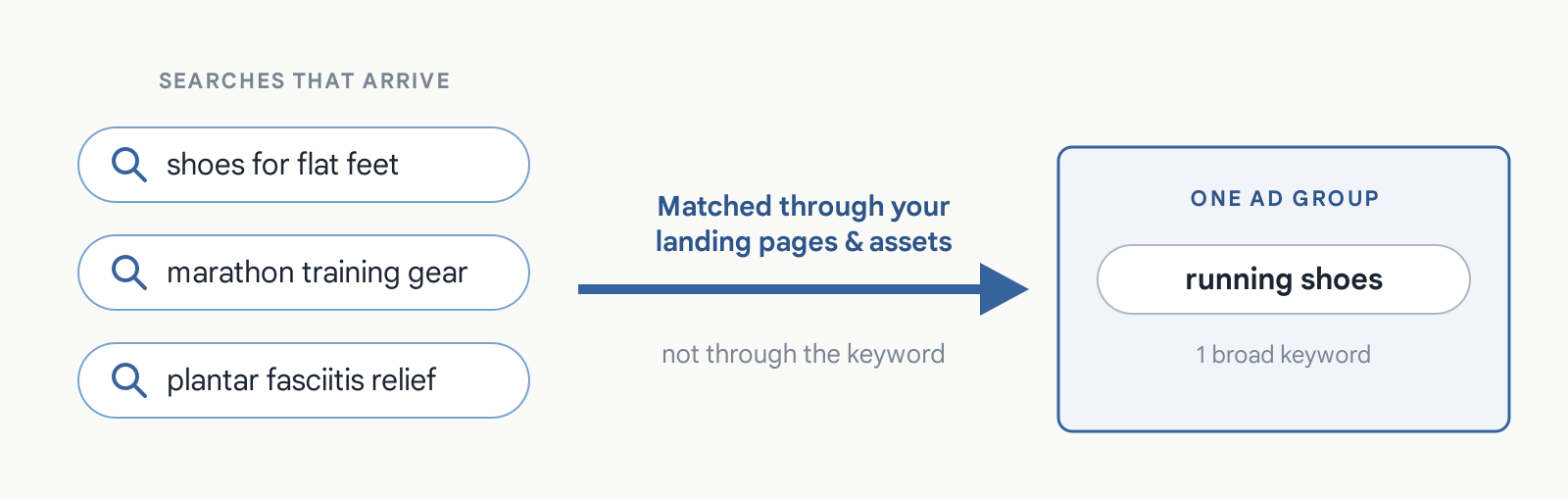
A SKAG in AI Max isn’t a SKAG. The name describes a structure that doesn’t do what the name says.
The tiers from the last post still hold. An exact match keyword identical to the search still takes priority, including against AI Max.
But if you’re migrating an existing campaign, there’s a detail in the documentation you’ll want:
When disabling the broad match campaign setting or moving to AI Max, broad keywords are not treated as exact match keywords in prioritization. To maintain this keyword prioritization without the broad match campaign setting enabled, add copies of exact match keywords in your new AI Max campaign (broad can be converted to exact, but that will remove historical keyword stats).
If you’ve got proven converting terms sitting in your account as broad keywords, they don’t automatically get that top tier when you move into AI Max. You have to add them as exact.
The conditions
Everything I’ve described comes with requirements, scattered across several pages.
From the setup page:
Features like search term matching, final URL expansion, and text customization require conversion-based Smart Bidding strategies in order to function effectively.
With manual CPC, Google says the search term matching feature won’t work at all, because AI Max relies on signals from automated bidding.
And if your campaign is limited by budget, Google says AI Max won’t be effective.
Put those together and there’s a profile of an account that shouldn’t turn this on yet. No conversion tracking, or tracking that doesn’t reflect real business outcomes. Manual bidding. A budget that runs out every afternoon. That describes a lot of small accounts, including most new ones.
If you want to be selective, search term matching can be switched on or off per ad group. Text customization and final URL expansion are campaign level.
On performance, Google says advertisers who activate AI Max will typically see 14% more conversions or conversion value at a similar CPA or ROAS. The source line: Google internal data, 2025, for non-retail advertisers.
And Google’s own advice is to wait at least two weeks after turning it on before making changes like adding negative keywords.
What this is really asking of you
One more thing from the documentation. Starting in February 2027, campaigns using Dynamic Search Ads will be automatically upgraded to AI Max. The FAQ calls AI Max an evolution of DSA and Performance Max with final URL expansion.
I was a fairly early user of DSAs, and that lineage is the most useful thing I can speak to about this.
DSAs did the same job on a smaller scale. Crawl the site, match queries to pages, generate the headline. I ran them on a site with a lot of strong organic content, people adding to it constantly, and they picked up real incremental conversions on long tail queries we were never going to build keywords for. It wasn’t enormous, but it worked.
It worked because there was a lot of content to match against. That’s the part I’d pay attention to.
So here are my conclusions for now.
It used to be that the advertiser with the most keywords in the tightest ad groups won. Going forward, I think it may be the advertiser with the most pages genuinely targeted to individual queries.
The difference is that the coverage used to live in your keyword list. Now it lives on your website. The confluence of organic and paid search that people have talked about for years keeps getting closer.
With one warning attached. The old version had a failure mode, which was building thousands of keywords for the sake of having them, ending up with a bloated account that didn’t convert. The new version has the same failure mode. Generating a hundred thin pages so there’s something to match against is the mistake in a new medium, and Google has spent twenty years penalizing exactly that in organic search.
It has to be real coverage. Pages that genuinely serve the query.
Which is an uncomfortable answer for a lot of local businesses, because building that is a different project than running ads. It may mean the person managing your campaigns has to start advising on what your website needs next.
I don’t know yet how far that goes, but over time I suspect I’ll have a clearer picture.